There is a house in the south of France that sits in its landscape like a geometric theorem — and yet feels, inside, like somewhere a family actually lived. That is rarer than it sounds. In 1977, when so many architects were pursuing either docile domesticity or pure conceptual bravado, Pierre Debeaux built something that refused both.
A Theorem in the Tarn
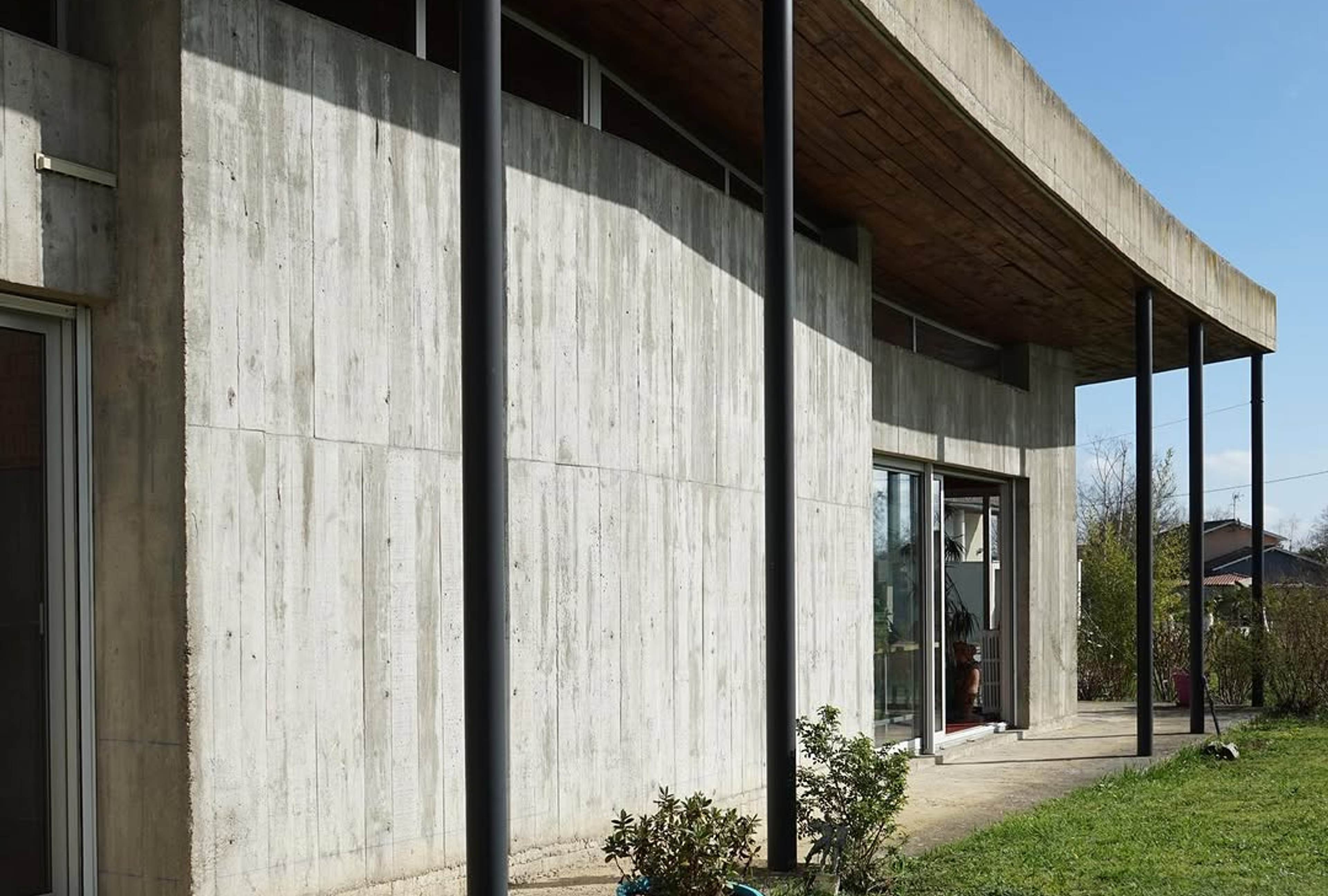
Maison Pradier, completed that same year on the rural edge of Lavaur, in the Tarn department of southwestern France, was conceived for a couple who wanted a home integrated with the surrounding countryside. Debeaux answered that brief with structural and spatial ambition: a single central concrete pillar anchors the entire building, from which the living spaces radiate outward in a complex polyhedral form. From the outside, the result is a volume that appears to hover — cantilevered, angular, slightly defiant of the gentle hills behind it.
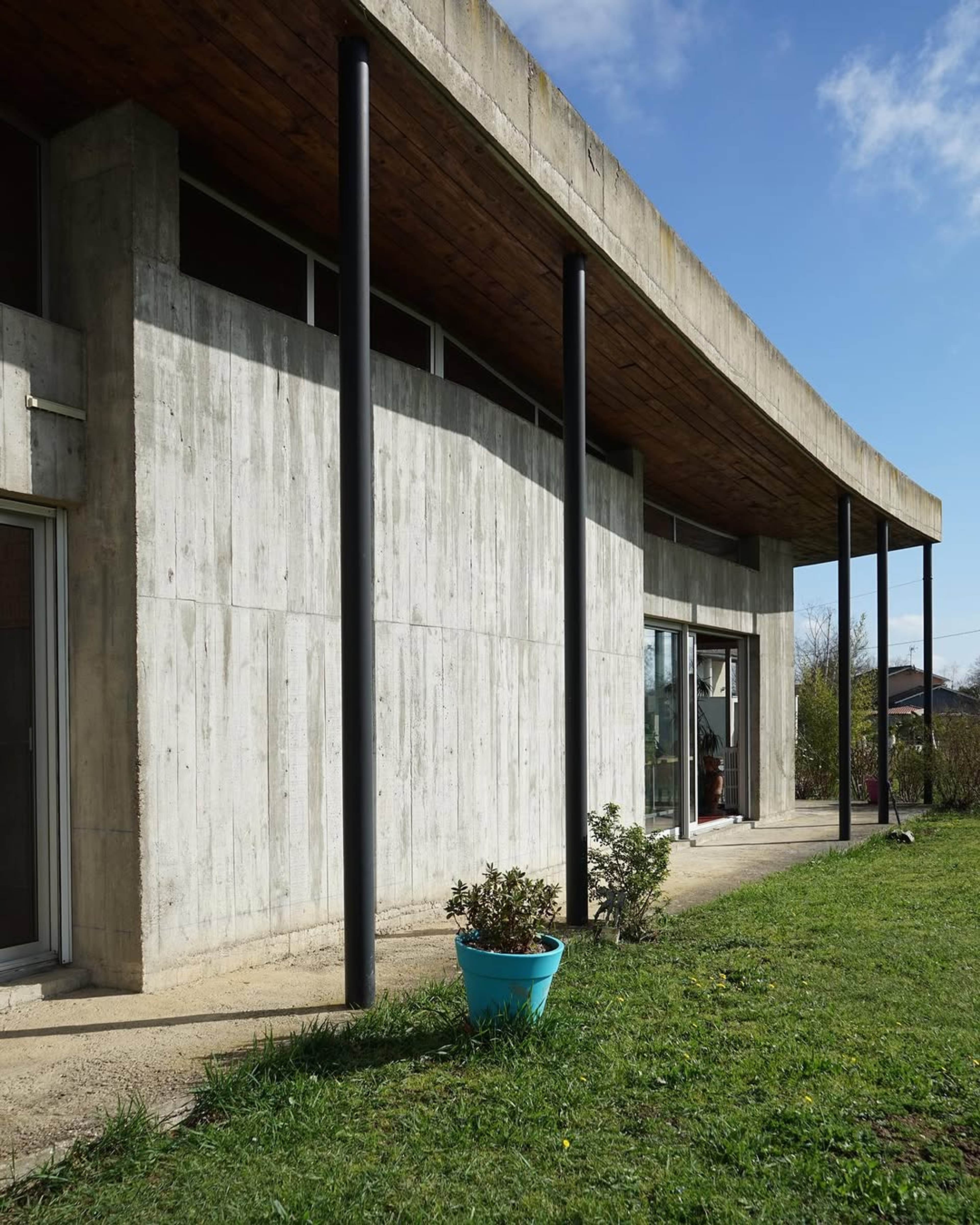
The exterior reads as pure structural logic: board-formed concrete walls bearing the texture of their own making, a wide overhanging slab supported by slender black steel columns along the garden facade, and a planted roof that, viewed from above, nearly disappears into the meadow.
Where Structure Meets Craft
"The pine ceiling does everything smooth plaster cannot — and Debeaux knew it."
What lifts Maison Pradier beyond formal exercise is what happens inside. Warm pine ceilings run across every room, their grain and knots doing everything smooth plaster cannot. Built-in cabinetry — crafted in light timber with dark wood edging and flush pulls — lines the kitchen and living areas with the kind of precision that speaks of an architect who designed right down to the drawer. Against the raw concrete walls, these surfaces create a conversation between the structural and the domestic that never tips into decoration.
The Staircase as Sculpture
The most arresting moment in the house is the staircase enclosure: a rough, bush-hammered concrete mass with a circular opening punched through it, framing the stair below in a form that reads as much sculpture as architecture. Radiating steel rods fan across the void like the spokes of something celestial. It is the kind of detail that could easily become theatrical. Here, it holds its weight.
Still Lived In, Still Alive
Photographer Adam Štěch visited in 2018 and found the house remarkably intact. His photographs show original light fixtures still in place — opal globe sconces on angular black brackets, tiered pendants in the long pine-ceilinged corridor — and a fireplace surround whose textured aggregate surface fills an entire wall with quiet mass. A "Vive la République" print hanging at the stair landing suggests inhabitants not simply preserving a time capsule, but living fully within one.
At a moment when architectural rhetoric defaults to sustainability metrics and lifestyle branding, Maison Pradier offers a different argument: that a building can be both intellectually rigorous and genuinely warm, that structure and craft can carry a house across half a century without reinvention.
The math is still there in the pillar, the angles, the polyhedral plan. So is the poetry — in the pine ceiling, the original kitchen handles, the way a circular void in rough concrete somehow makes a stairwell feel like a room worth arriving in.
Photos: Adam Štěch